How Much Does Poshmark Take? 20 Percent of a Number Poshmark Does Not Define
Four marketplaces print a seller rate on a page you can read before you list anything. Only three of them print what the rate is a rate of, and once the same coat goes through all four, the headline percentage stops being the number that decides anything.
 ·
· 
October is when the coat you didn’t wear last winter becomes a decision, and the search that follows it is almost always some version of how much the app is going to keep.
There are more marketplaces for one coat than anyone is going to read the terms for, so the test here was kept narrow enough to finish in a morning. A marketplace qualified if you set your own price, if the garment ships out of your own closet instead of a bag you mail to a warehouse, and if the fee is printed on a page the company itself links to. Four cleared all three on September 30, 2026: Poshmark, eBay, Mercari and Grailed.
Two didn’t clear, and the reason belongs here rather than in a footnote. Depop returned a 403 to every request from this desk, so nothing of theirs is described below. Vinted’s robots file names our crawler specifically and tells it to stay off the site, so we stayed off, which means Vinted may well be cheaper than all four of these and we have no standing to say.
The four numbers that came back look like an easy decision. Poshmark takes 20 percent, Mercari takes 10, twice as much for the same coat.
It isn’t that, and the percentages are not where the problem lives. It’s the bases.
What does each marketplace say it takes?
Poshmark prints the plainest sentence of the four. Its Fee Policy, which the Terms of Service names as a document incorporated by reference, reads: “After your item sells, we deduct a small fee from the final order price. For sales under $15, the fee is a flat rate of $2.95. For sales $15 and above, the fee is 20% and you keep 80%.” Shipping is handled by what the same page calls “PoshPost, our frictionless buyer-paid flat rate shipping program.”
eBay prints more and prints it in pieces. Most categories run “13.6% on total amount of the sale up to $7,500 calculated per item,” plus a per-order fee: “For orders $10.00 or less the per order fee is $0.30, for orders over $10.00 the per order fee is $0.40.” Listing is free up to a point, since “every month, you get 250 free listings.”
Mercari dates its rate. Sellers pay “10% of the item price + buyer-paid shipping,” buyers pay “3.6% of the combined amount of item price and buyer-paid shipping,” and both took effect January 6, 2025. Taking the money out costs separately. Instant Pay is “$3 flat fee per cash-out,” and there’s a “$2 non-refundable fee for each failed direct deposit request.”
Grailed splits its rate at a price. The table shows 9 percent at “$120 and above” and 6 percent, minimum $1.99, “Under $120,” the reduced tier marked as applying to sales on or after 5/20/26. Then one line that matters more than the table does: “Please note this fee is separate from a payment processing fee.” That second fee is 3.49% + $0.49 on US domestic payments for a seller onboarded with Stripe.

The same coat, listed four times
A wool coat at $100, with $10 of shipping paid by the buyer, and nothing else allowed to vary. That’s the only experiment here, and the thing being tested is not the rate but the base.
| Marketplace | Printed seller rate | What the rate applies to, in its own words | Commission on the $100 coat |
|---|---|---|---|
| Poshmark | 20%, or flat $2.95 under $15 | “the final order price”, undefined on the page | $20.00 |
| eBay | 13.6% + $0.40 per order | “the cost of the item and shipping, sales tax, and other applicable fees” | $15.36 to $16.41 |
| Mercari | 10% | “the item price + buyer-paid shipping” | $11.00 |
| Grailed | 6% under $120, 9% at $120 and above | listing price, plus buyer-paid shipping unless you use a Grailed Label | $6.00 or $6.60 |
Four rates spanning 6 to 20 percent produce commissions spanning $6.00 to $20.00, which is the shape you’d expect. What you would not expect is that two of the four cells in the third column change the answer, and one of them is empty.
Why does eBay’s cut depend on where your buyer lives?
eBay states the base in one sentence and the sentence is unusually complete: “This fee is calculated based on the total amount of the sale, including the cost of the item and shipping, sales tax, and other applicable fees.” Sales tax is in there. eBay collects that tax from the buyer and remits it, so the seller never holds it, and the seller is charged a percentage of it anyway.
Run the coat twice. A buyer in a state with no clothing sales tax makes the base $110.00, so the fee is $15.36. A buyer facing 7 percent makes the base $117.70, so the fee is $16.41. Same coat, same listing, same seller, $1.05 apart, and the only variable is the stranger’s address on the label.
A dollar is not a scandal. What it tells you is that eBay’s 13.6 percent is not a property of eBay but a property of the transaction, and part of the transaction gets decided by someone you’ve never met, after you’ve already set the price.
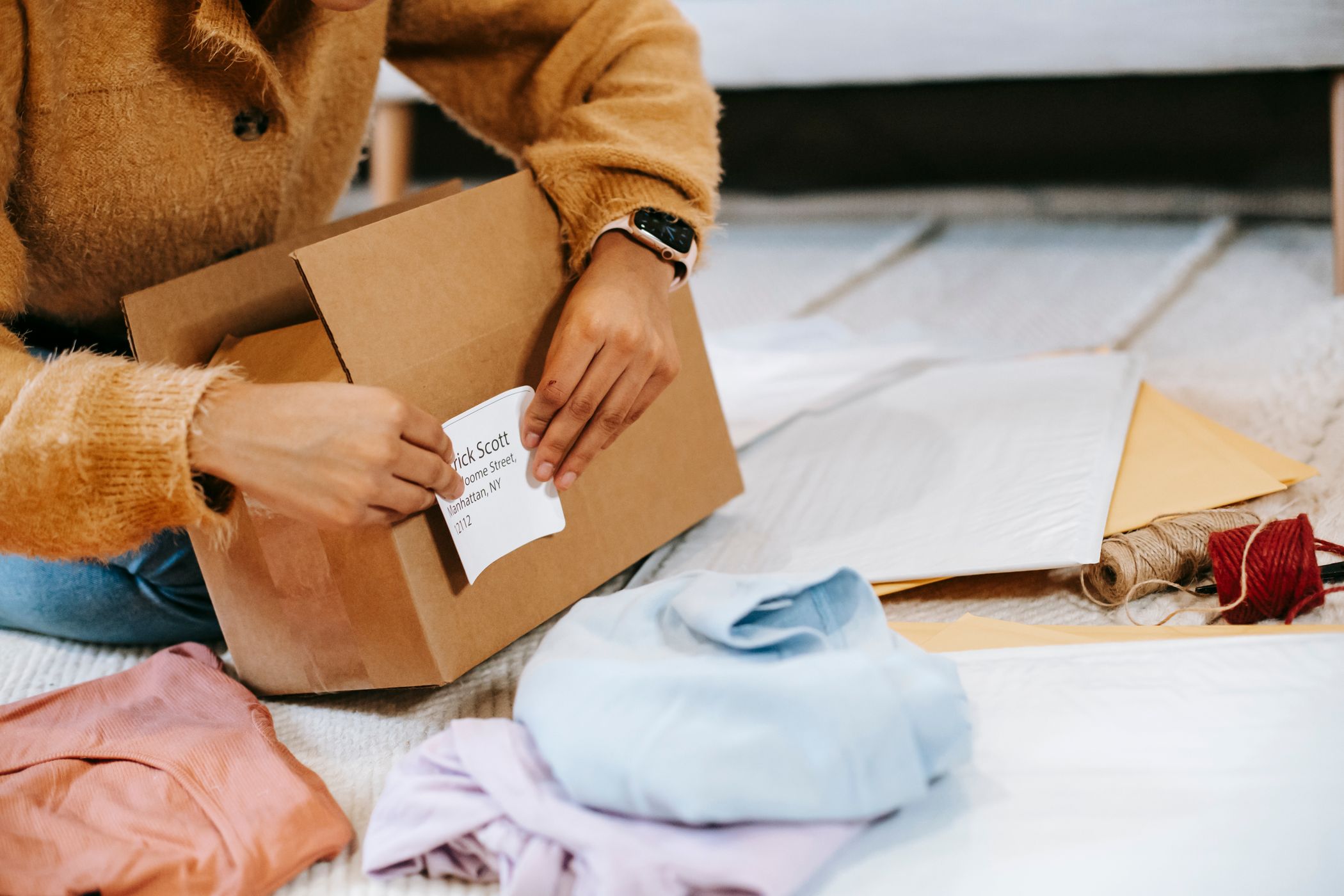
What is Poshmark’s 20 percent 20 percent of?
Poshmark’s own answer is the phrase “the final order price,” and the page that phrase appears on never says what goes into it. The same document is in two minds about its own boundary, too. The Fee Policy body says the flat $2.95 applies “under $15” and the 20 percent applies at “$15 and above,” while the change notice higher up the same page says the flat fee covers sales “$15 and under” and the percentage covers sales “over $15.” At exactly $15.00 the page prints both rules, which is a five-cent disagreement and a reminder that nobody proofreads a sentence they already know the answer to.
We have not sold anything on Poshmark and are not going to tell you from experience what the base turns out to be. What’s checkable is this: three of the four marketplaces define their base in writing and one does not, and the one that doesn’t is the one with the highest rate. Read the flat fee at the bottom of the range for the real sting. A $5 item carries $2.95, which is 59 percent, and that’s printed clearly enough that nobody can claim surprise.
Why can listing for $2 more leave you with less?
Grailed sets its commission tier by the sale price, and the sale price is not the listing price unless you choose it to be. The help page is explicit: the figure is “the listing price your item sells for, plus any shipping costs charged to the buyer, if you are not using a Grailed Label,” and “if you use a Grailed Label, the sale price is based on the listing price only.” The base is a seller decision, which is the only instance of that in the four.
Put a coat at $109 with $10 of buyer-paid shipping and no Grailed Label. The base is $119, under the threshold, so commission is 6 percent, or $7.14, and processing adds $4.64, for $11.78 in fees. Move the same listing to $111. The base crosses to $121, the rate jumps to 9 percent, commission becomes $10.89, and total fees reach $15.60. After the label, $97.22 becomes $95.40. The label’s the lever.
Two dollars more on the sticker, $1.82 less in your account. That’s the tier line.
Where the chain goes dark
Four segments of this chain are visible: your listing price, the marketplace’s commission, the payment processor’s cut where it’s broken out, and the shipping money moving in one direction or another. Four more are not, and pretending otherwise would be the easy part of this job.
Poshmark’s base is the first gap. Grailed prints its processing rate but we couldn’t confirm from the page whether the 3.49% + $0.49 lands on the item alone or on the item plus shipping, so the $4.64 above is our arithmetic on the full transaction and should be read as an upper bound rather than a quote. Grailed also warns that “promotional commission rates may apply to certain transactions,” which means a rate you read today may not be the rate you’re charged, and the company reserves the right to tell you separately. And none of the four prints what the buyer-side fee does to your odds of selling at all, though Mercari’s buyers now pay 3.6 percent on top, which on the coat is $3.96 that someone has to feel.
So which app should you use?
On the printed numbers alone Grailed keeps the least and Poshmark keeps the most, and if that’s all you came for, there it is. The ranking holds at $100. It would reorder at other prices, because eBay’s apparel rates are not one rate. Sneakers over $150 run “8% on total amount of sale. The per order fee is not charged,” and women’s bags and handbags run “15% if total amount of the sale is $2,000 or less.” A $200 pair of trainers and a $200 handbag, listed by the same person on the same afternoon, are charged almost double one another.
Which is the actual finding, and it’s a duller one than a ranking. The fee you pay is not a property of the app you chose. It’s a property of what the thing is, what the buyer pays for postage, which label you print, and where the buyer lives, and three of those four get decided after your listing goes up. We’ve read enough of these documents by now to say that the pattern repeats elsewhere, in the buyback tables brands print for your old clothes and in what a resale platform promises when it authenticates something.
So ignore the paragraph above. Comparing the four rates is the wrong exercise, and we only ran it because it’s the thing everyone searches for. The number to find before you list is not the percentage. It’s the sentence underneath the percentage that says what it’s a percentage of, and on one of these four that sentence does not exist.